

Pibble
Compact watercolor case for live sketchers.
Industrial Design
Simple Product Design, Designing for the user, Product visualization and conceptualization.
Individual Project, 2022, redesigned in 2025
Duration: 2 months + 1 month
Guide: Mr. Vikram Mitra
Tools: Rhino, Key Shot, Sketching, Workshop prototyping, Adobe Lightroom
Brief: A watercolor kit that is compact, functional and reduces the number of separate components carried by the user for regular and outdoor sketching.
About the project:
My first design project at NID and one very close to my heart, Pibble began as a way to solve a personal problem I had with watercolors; they are difficult to carry, set up and clean up, especially when live sketching. The multiple components and highly personalized choices that come with the medium are what made finding the perfect solution for all users a challenge. Although Pibble is not "perfect" , the redesigned version solves most of the problems that come with live sketching. My love for stationery and art shines through this project, and I chose to redesign it to see how far I have come as a designer. I might redesign it yet again in the future to keep track of the progress :).

So, what does Pibble do?
Pibble helps you efficiently carry various tools like watercolor pans, pallets, brushes, pencils etc. in minimal amount of space, making it ideal for both outdoor and indoor sketching. Its outer case also transforms into two separate water containers to clean and wet your brushes.


The process and intent
Primary Research


I conducted workshops and attended live sketching meet-ups by the urban sketchers to talk to people about their experiences and observe them in action. Apart from that, I also interviewed professional artists and gained insights into the diverse ways people prefer to use the medium.

I also did a thorough product comparison with existing products I could find around me and products I found online.

I made flow charts with the information I received through interviews and task analysis, noting down the key issues that seemed to be repeating across various stakeholders.

Analyzing the information I received to create parameters for where I want to intervene, aka, defining my brief.

The brief formulated through research and analysis was:
To design a watercolor kit that is compact, functional and reduces the number of separate components carried by the user for regular and outdoor sketching.
Ideation sketches
.jpg)
.jpg)
.jpg)
.jpg)
.jpg)
.jpg)
.jpg)
.jpg)
.jpg)
.jpg)
.jpg)
.jpg)
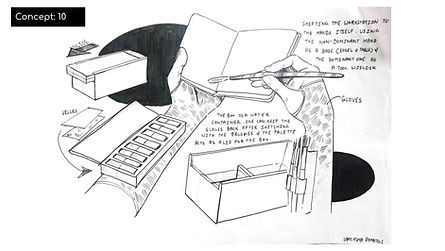
I began ideating with the intent to create an efficient way of storing and carrying multiple materials.
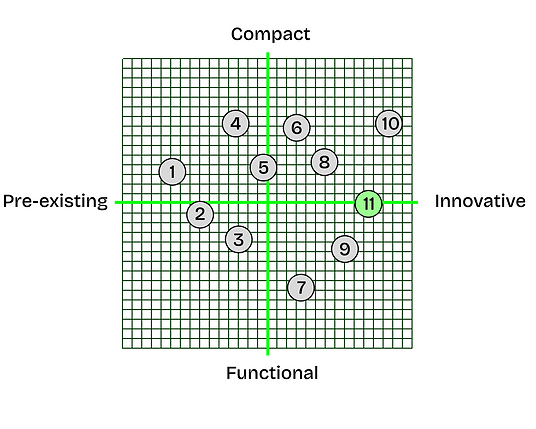
This was the selected idea, after placing all the ideas on a comparative matrix
The criteria for the selection was based on how the idea fit into:
1. Compactness - space distribution and utilization
2.Innovation - something new
3.Functionality - practicality for manufacturability and use
4. Pre-existing - a solution that already exists.


The executed idea
This was originally a 2nd year project, back when I had no idea on how to use CAD. I had to rely solely on prototyping using the workshop, all by hand with minimal use of laser cut and vacuum forming machines, cutting and pasting polystyrene by hand. Though it took me an extensively long time to make this prototype, I learned a lot, even though it turned out to be a "failed" attempt.
Feed back from users
Although most users loved the product, especially the provision to clean the brushes in two separate bowls to segregate hues, and the storage area, they pointed at how large the prototype was, which I had made based on my A5 sketchbook.
I understood that it wasn't necessary for the product to match a certain size or fit onto a sketchbook this way. Another feedback was on standardizing the palette sizes and protecting the brushes. I took this feedback to heart and reworked on it, even though it was 3 years later.


I refined my initial idea, reducing the dimensions and making sure that I do not waste any precious space. I ended up with a much compact-er idea!
This time, I did a thorough analysis of potential products! I studied various forms, finishes, materials and use case.!
Developing a mood board by selecting what fit the best with the product was much simpler after I understood the concept I was going for.
Form ideation was something I hadn't considered earlier, but with feedback, I learned that even the simplest of objects can be unique.
Steps to improve the design.
Mood board keywords:
Cute
Soft
Pebble-like
Colorful
Containers/stationery
I tried to find softer forms which resembled the mood board.
I started off with a pen and paper again, scribbling away at the ideas I had in my mind.

Refined concept
This is the final sketch of the product, where I went ahead with a transparent ABS case wrapped with a silicone band, containing the watercolor box. This idea ticked (almost) all the boxes now - Form, function and feasibility. All that was left to do was to make it come to life!


This time, I made a quick mock-up to test the idea instead of a form accurate prototype. This worked better for charting out the dimensions I had in mind quicky, and I was able to make changes to it without investing time.

Pibble
Your live-sketching buddy

More than just a watercolor box, it's a kit that allows you to comfortably sketch just about anywhere!
Pibble lets the user carry up to 8 brushes, or short pencils, 12 pans, 3 mixing palettes and 2 bowls.

The new dimensions are about 1/3rd the original one, making Pibble way more easy to carry and light-weight.
How to use Pibble


The case breaks open in two equal shells.
It has provisions for mixing colors and 12 pans.
1
2


The Palette can be removed to reveal a storage area.
This area can house up-to 8 foldable brushes, in this case, 4 brushes, 2 short pencils and an eraser fit comfortably inside the case.
4
3

The brushes have a very simple yet protective design, the brush cap can be attached at the back of the brush to increase its length, and put back on to reduce the size and secure the brush when inside the box.
5


To further improve the compactness, the water shells can be attached to the box. This reduces the area needed to work on the medium, and can mediate single hand operations if they choose to sketch while holding this, or their sketchbook.
6


The key to being better is not being satisfied with the first outcome. I would never have improved if I thought that the prototype was just it. Re-working on this brief made me realize just how far I have come... and how far I am yet to go.
Prototyping the new version soon!